
Live sessions on the tools researchers actually use. You bring the question or the dataset. We work through it on Zoom, and you leave with an e-certificate.
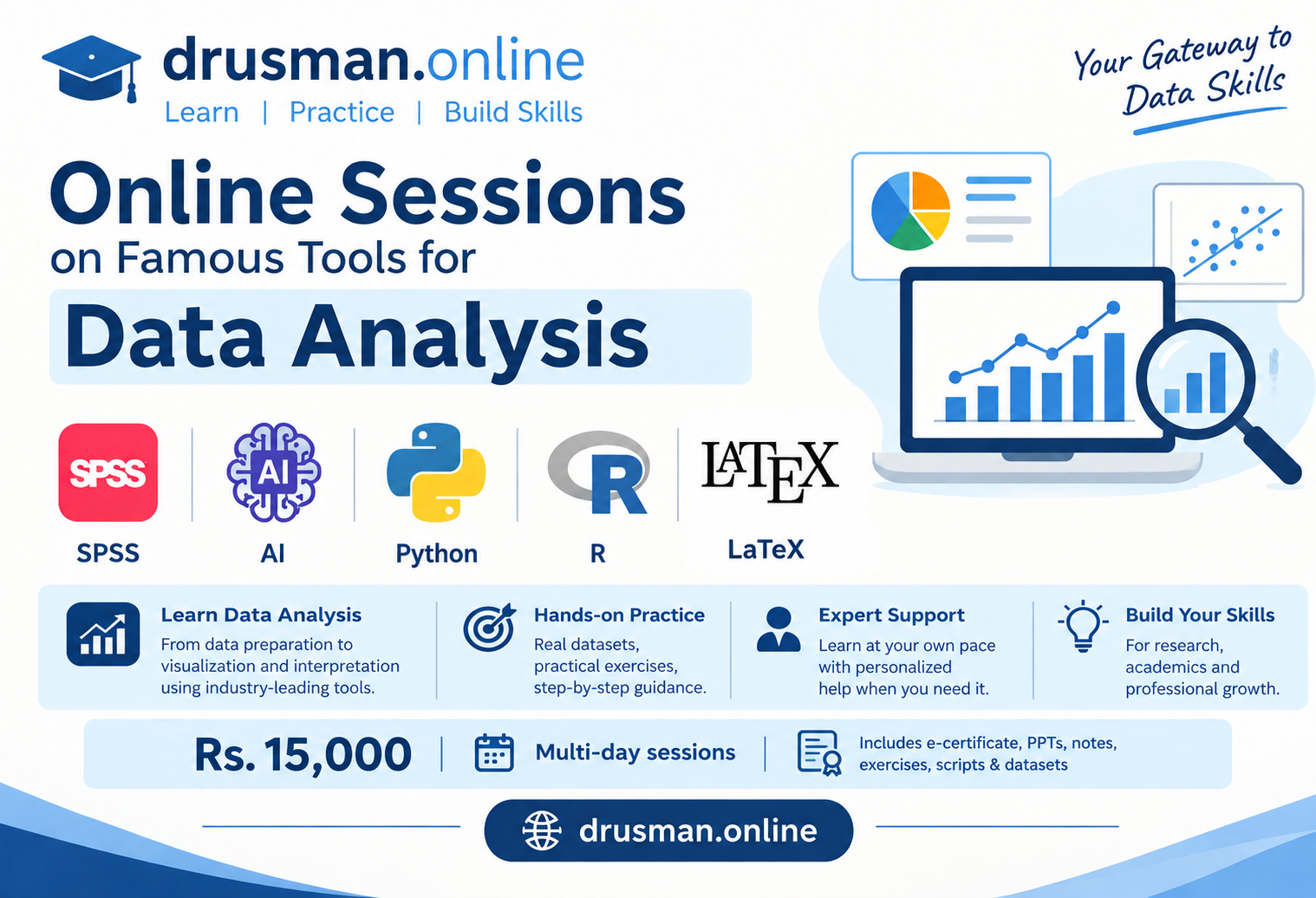
Each of these is a separate course. Open the one you want.
A beginner course in entering, cleaning, and analysing data in SPSS.
A beginner course in LaTeX for papers, theses, and presentations.

A beginner course in using AI tools for research, teaching, and everyday work.
A beginner course in Python, from first programs to data analysis.

A beginner course in R for research data, tests, and figures.
The page presents your online courses as practical, instructor-led training designed for people who want to develop skills in research, data analysis, scientific writing, and modern AI tools. The central idea is to help participants learn the software and technologies they actually need for their academic, professional, and research work, rather than simply studying theoretical concepts. Delivered through live Zoom sessions, the training can be arranged on a one-to-one basis or in small groups, making it suitable for participants with different learning needs and levels of experience. Each course is offered separately, allowing learners to select the subject most relevant to their goals. Participants can bring their questions, datasets, or practical challenges to the sessions and work through them with guidance. The training is particularly relevant to university students, postgraduate and PhD scholars, faculty members, teachers, researchers, data analysts, and professionals who wish to improve their technical capabilities. Whether someone is beginning their research journey, preparing a thesis, analyzing survey data, developing programming skills, or exploring AI-assisted work, these courses provide a structured and accessible starting point. The emphasis is on learning by doing: understanding the essential concepts, observing demonstrations, practicing the techniques, and developing the confidence to apply the skills independently after the training. An e-certificate is also provided upon completion of the course.
The available courses cover five complementary areas. SPSS — Statistical Analysis for Beginners introduces participants to data entry, data cleaning, descriptive statistics, hypothesis testing, correlation, regression, and the interpretation of statistical results, making it especially useful for survey-based studies, theses, dissertations, and social or applied research. LaTeX — Research Papers and Technical Documents for Beginners focuses on preparing professional research papers, theses, technical reports, mathematical equations, tables, figures, and bibliographies, helping researchers produce well-structured academic documents. Artificial Intelligence — AI Tools and Applications for Beginners explores the practical use of AI tools for research, teaching, writing, information processing, and everyday professional tasks, including effective prompting and responsible use. Python — Programming and Data Analysis for Beginners provides an introduction to programming, data handling, analysis, and visualization, with opportunities to develop practical skills that can later support automation and machine learning. R — Statistical Analysis and Data Visualization for Beginners focuses on statistical computing, research data preparation, statistical tests, and the creation of clear, informative visualizations. Together, these five courses address important stages of the research and professional workflow: preparing and analyzing data, interpreting findings, presenting results, writing scientific documents, and using emerging technologies productively. Participants can choose an individual course according to their immediate needs, without having to enroll in all five. The training is intended to make SPSS, LaTeX, Python, R, and AI approachable for beginners while providing practical foundations that learners can build upon in their subsequent academic or professional work. Explore all five courses and arrange an online session.
One-to-one and small-group sessions on Zoom. More names will be added as further sessions are held.
| Name | Role | Organisation |
|---|---|---|
| Ms. Ifra Kiran | Monitoring, Evaluation and Knowledge Management (MEKM) | Food Security and Agriculture Center of Excellence, Rawalpindi |
| Mr. Muhammad Anees Ijaz | PhD Scholar | Beihang University, Beijing, China |
| Dr. Junaid Khan | Medical Officer | Pakistan Institute of Medical Sciences, Islamabad |
| Dr. Qurat-ul-ain | Medical Officer | Holy Family Hospital, Rawalpindi |
| Dr. Hassaan Shafqat | Consultant Neurologist | Government of the Punjab |
| Ms. Shehla Adnan | Associate Professor | Fatima Jinnah Women University, Rawalpindi |
| Dr. Gulnaz Akhtar | Librarian | Fatima Jinnah Women University, Rawalpindi |
| Ms. Zahra Gull | PhD Aspirant | National University of Sciences and Technology (NUST), Islamabad |
| Dr. Ameer Mahar | Director (Admin) | PEMRA, Islamabad |
| Ms. Rabia Zafar | Lecturer | Bahria University, Islamabad |
| Dr. Mustafa Ali | Researcher | University of Manchester, UK |
Tell me the topic, whether you want one-to-one or a group, and a few times that suit you.