The 0.02%: Pursuing Knowledge Behind the Poverty Line
A 32-year-old PhD scholar studying at local university spends the day at a full-time job, returns home to family responsibilities, and begins research after midnight. A foreign PhD student, often supported by limited resources and living under financial constraints, carries the additional burden of sustaining family commitments back home while balancing full-time research, part-time work, and academic expectations abroad. This is not an exception for Phd scholars from lower-middle-class societies, it is often the norm. In a country of approximately 240 million people, PhD holders and doctoral students represent only a tiny fraction of society, roughly 0.02%.
Almost 23% of the Pakistan population is living below the poverty line (at $3.00 per day) according to World Banks Report of 2024. In the last three decades, the rate has potentially decreased from ≈81% in 1987 to ≈17% in 2018. There has been, however, a steady increase since 2018 onwards, as the poverty rate lied around 23% in 2024. This pattern looks similar to the pattern we see between 1996 and 2001. One could say the population growth could be a reason, but the data suggest that there has been a steady increase in population throughout these years. The most recent increase in the poverty ratio is often attributed to the 2022 floods, however, there may be other hidden factors.
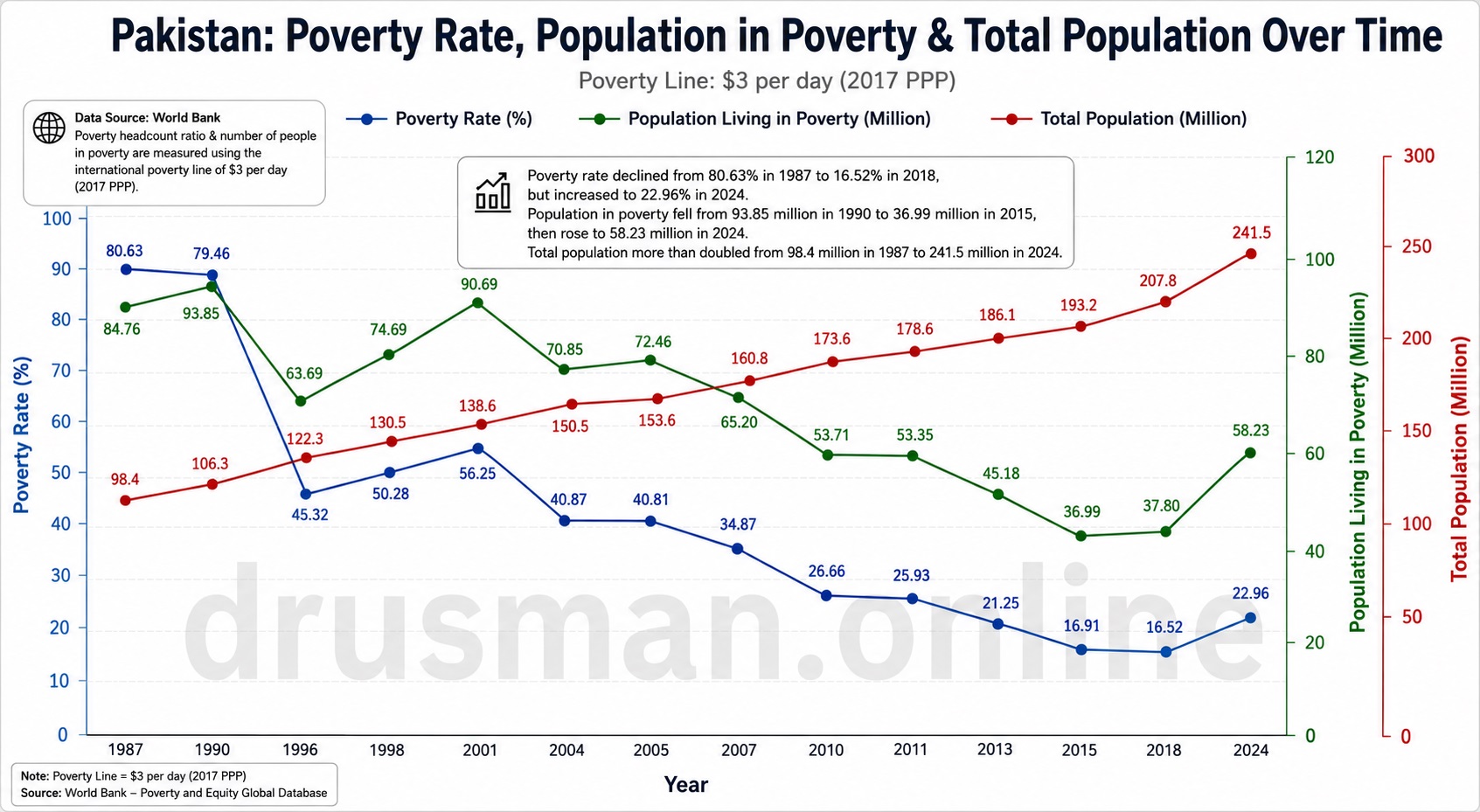
Pakistan: Poverty Rate, Population in Poverty & Total Population Over Time.
A striking observation is that only 4-6% of the population has completed higher education according to HEC's graduate data published across different years. In addition to that, according to HEC's report of 2024 on PhDs, the number of PhDs produced in the country stands around 0.015%, i.e. ≈35,000 individuals. These numbers do not include foreign graduates. However, even after accounting for them, the cumulative total is unlikely to exceed 50,000, which represents less than 1% of the population. In fact, it would still amount to only about 0.02% of the total population.
The relationship between poverty rate and higher education is debatable, as the increase in graduates may not necessarily mean that the poverty rate will decrease. The latter majorly links to industrialization, economic growth, and entrepreneurship as well including some other factors, apart from education. However, high poverty rates inevitably influence the educational landscape, affecting the number of students who can progress to advanced degrees such as an MPhil/MS or a PhD. The data reflects that a large number of graduates don't progress to advanced degrees.
Since 1970s, majority of individuals who travelled abroad, target jobs overseas. The data reflects that Pakistan has sent over 10 million workers abroad since 1971. According to the Bureau of Emigration and Overseas Employment, upto 2006-07, the number of emigrants stayed well under 250,000. However, since 2008, only around 2020, the this number went below 250,000. Perhaps in the era around 2020, Covid19 pandemic played a big role in the declining ratio due to travel restrictions imposed by different countries. The recent data shows that Pakistan is sending 700,000-900,000 workers abroad per year recently. In comparison, the number of students who travel abroad, don't cross 60,000 even, according to the Trading Economics Website. An interesting fact, however, is that the number is increasing every year, similar to the rate of people going abroad for employment.
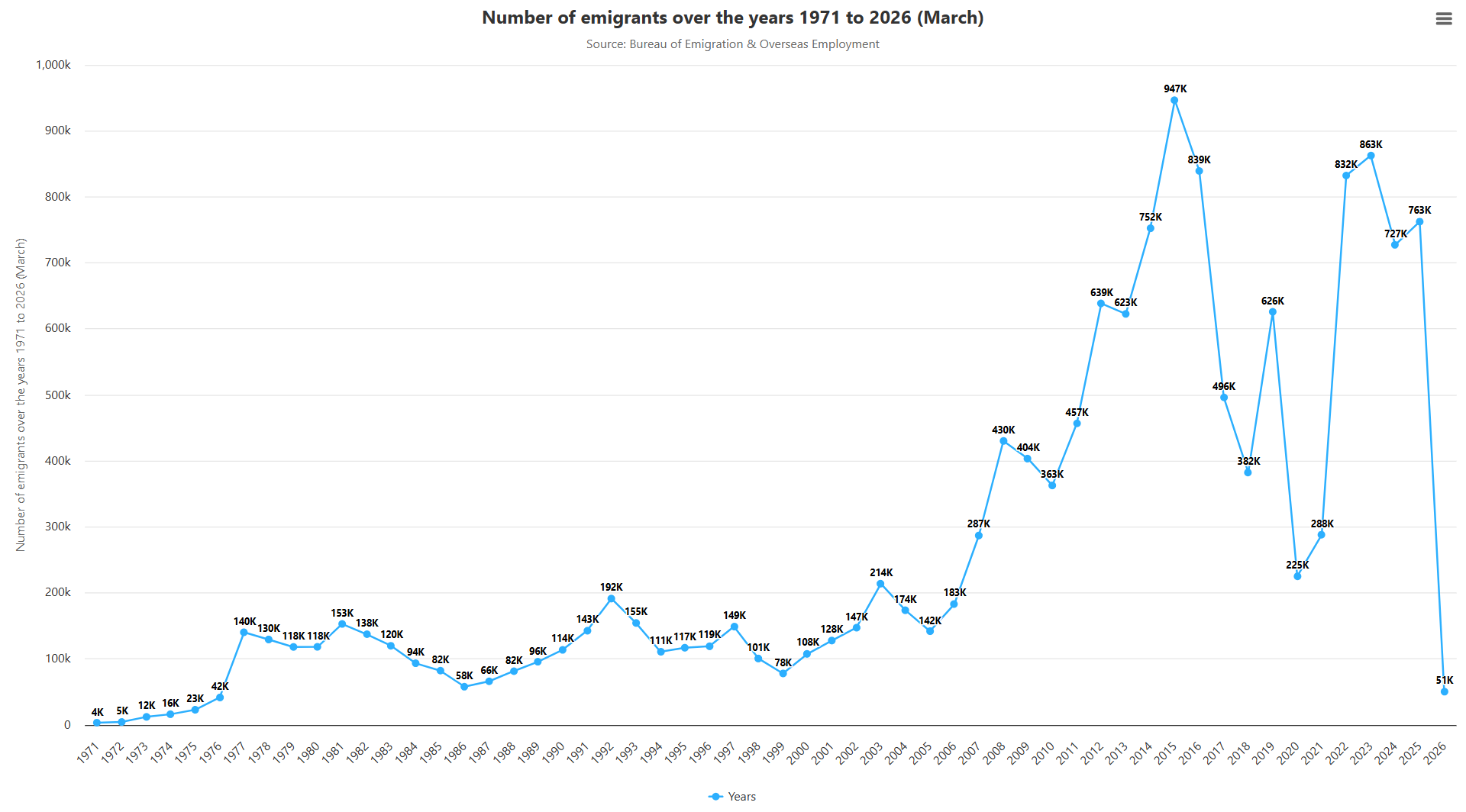
Pakistan: Number of Emigrants Over Time.
These statistics certainly show the general phenomenon as pointed out by the Maslow's hierarchy of needs that:
"When a society is preoccupied with meeting basic needs, fewer resources and opportunities remain for research, innovation, and advanced scholarship."Research often requires long-term commitments, along with stable institutions, and infrastructure. Therefore, in countries like Pakistan, the priority becomes meeting the basic needs. Given the economical conditions in the country, people travel abroad to help their families meet basic needs of living, and a smaller number travel for higher education.
Higher education helps fixing the poverty rate. Similar to many developing countries, people pursuing the higher education path are negatively affected due to the poverty rate. Nearly 9.6 to 14.4 out of 240 million people have reached the graduate level, whereas only 50,000 people reached the PhD level. These PhDs are supposed to play the role of mitgating the poverty rate, however, the way they persue the PhD journey and the way they end up in the system requires some review, attention, and fixes. Only then, they will be able to help in lowering the poverty rate.

The 0.02%: Pursuing Knowledge Behind the Poverty Line
The majority of these PhDs are highly ambitious, and are affected by the poverty line. These are enthusiastic individuals, who not only see higher education as one of the solutions to fix the poverty issue, but also believe in taking a step further, by achieving the highest degree in their domains. Unfortunately, this highly motivated group of people come across several challenges, mostly caused by the poverty itself.
Family support vs academic dreams:
PhD scholars are usually part of lower middle class, or middle class, wherein families always look to their kids for support once they reach the age of ≈30 years. The PhD journey mostly starts around the same age. That requires the scholars to earn while studying. It is difficult to keep a balance between the academic venture and family.
Funding the PhD Locally:
PhD scholars must hunt for a scholarship, or have a job that requires them to work full time to pay the fee, and run their families. The research grants and local scholarship opportunities in Pakistan are comparatively below low in numbers. In particular, local scholarships are limitted, and in most cases not more than a few thousand rupees barely enough for day-to-day expenses of a single individual. A high percentage of people doing local PhDs are working full time to support families. Compared with foreign PhDs scholars, they are unable to devote proper lab-hours affecting the quality of their research work.
Funding the PhD in Foreign:
PhD scholars mostly look for foreign scholarships to tackle the poverty line issue. Due to better funding, there is a chance to tackle the family support and self-finance at the same time. The foreign scholarships are highly paid in comparison, and its easy for the scholars to send money home, while studying for free. That makes life easier, however, it comes with its own challenges.
The Long Shadow of Early Educational Disadvantage
The difficulties faced during primary school, secondary school, and undergraduate studies do not disappear at the PhD level. In general, PhD scholars don't receive quality school/college education, often resulting in substandard writing skills, lower critical thinking levels, and communication problems. They accumulate and affect writing, critical thinking, communication skills, and research confidence years later. Research consistently shows that educational inequalities have long-term effects on academic achievement and opportunities.
Delayed/Compromised Marriages:
The decision to start a PhD career is always hampered by the confusion within the family. If the student is starting a PhD locally, the early marriage adds gradually to the financial burden. In some cases, the family life is affected, and the rate of effect depends upon the stage of family life. If the individual is starting a PhD abroad, the family might pressure the individual to get married before leaving, and/or insist on taking the spouse with him/her. In such cases, the financial burden may not be a big issue, however, leaving out the spouse at home in early marriage days creates chaos within the family. We have seen cases where the male scholar shifted to a foreign country just after marriage, whereas his female companion stayed home, looking after his family/extended family, create many complications. We have also seen some cases where a female scholar moved to foreign just after marriage for a PhD degree, making the relationship very complex. Many scholars delay their marriages in pursuit of foreign PhD, making it a post-degree event. The delayed marriage often creates issues, if the scholar has siblings reaching the marriage age, making it hard for parents to make a decision in their growing age.
Social Issues:
Perhaps one major difference between local PhDs and foreign PhDs is the social life. While the local PhDs may enjoy, take part in social life, for instance, meeting friends, attending marriages, funerals, family events, and other seasonal/religious events, the foreign PhDs don't invest much time in such activities or may not have opportunities being in foreign community. On one hand, its good to be social, but on the other hand, its difficult to keep up with the academic progress. We have seen that PhD scholars studying local, could not devote time to studies over weekends due to social commitments, as many in jobs leave out their academic work to weekends due to job routines. Foreign PhDs have lesser social commitments, and devote their time in a better way to studies throughout the year.
Quality Publications:
One of the major problems in several domains is the ability to publish in high quality journals while studying in local universities. There have been cases where a journal articles or a conference submission was given a very tough scrutiny, submitted from Pakistan, and at the same time, a similar article was given relaxed scrutiny increasing the chance of publication. The reputation of local universities and foreign universities matter a lot in the publication of articles. PhD scholars studying local find it tough to publish. Secondly, writing quality publication while studying at local universities along with the funding problems, social issues, and family problems, is a challenging task. While there are paid venues which might relax the review process a little, finding finances for such payments may get tricky. For foreign graduates, usually, the publication process has advantages. However, we have seen cases where even highly talented individuals find it difficult to meet the publication standards. This challenge is often rooted in earlier educational disadvantages, as socio economic hardships can limit access to quality learning opportunities, mentorship, resources, and academic exposure, with effects that may continue to influence research performance and scholarly development years later.
Life after PhD:
In general, although there is no authentic data available, the majority of foreign PhD graduates as well as local PhD graduates prefer to stay or leave abroad to progress further in their research domains. In Pakistan, PhDs are only able to earn positions in the Universities/Institutes for teaching the undergraduates and graduate students. Compared to the developed countries, there are no major research institutes/organizations with the capacity to absorb these individuals or offer high income for better living.
As time progresses and current trends indicate, the number of PhD graduates is expected to increase. However, producing high-quality PhDs while many are studying under the constraints of poverty remains a significant challenge. Moreover, we are still far from fully realising the impact of higher education on alleviating poverty.